The introduction read a car's grip out of its own data. This page is that chapter's lesson: the same ground one layer deeper, the why behind each claim it made, and a short test at the end. Every number here is the introduction's number, from the session cited on that page.
Why turning counts as acceleration
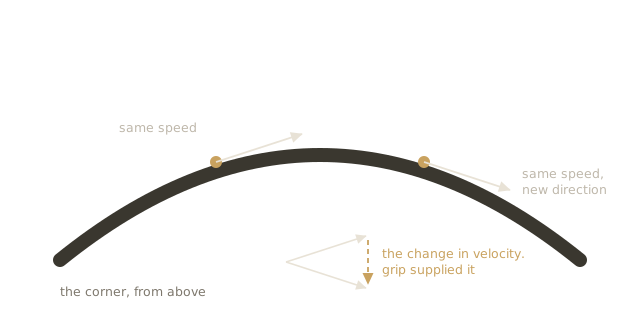
Velocity is not just a speed; it is a speed in a direction. Change either one and the car is accelerating. A car holding a perfectly steady 150 km/h through a corner is accelerating the whole way, because its direction is changing every instant, and something has to force that change. That something is grip. This is why a simulator can stream cornering as a channel at all: the sideways acceleration and the braking acceleration are the two components of one quantity, the car's acceleration, and Newton's second law converts what the tires did into what the channels show. One g is the acceleration of ordinary gravity, 9.81 meters per second per second, and it is the unit the whole series is written in.
Why racing rubber beats the schoolbook
The friction taught in school says the sideways force between two objects is the pressing force times a coefficient, and the coefficient stays comfortably below one. That law describes rigid bodies sliding on each other. Rubber is not rigid. Pressed against a road it flows into the microscopic texture and interlocks with it, and its compound genuinely adheres to the surface, a molecular stickiness. Both effects grow as the rubber is pressed down harder, and neither is available to a rigid block of steel. That is how the introduction's car corners at 2.32 g in its slowest corners, more than double what road rubber manages, and it is why racing compounds pay for that grip by wearing out in hours instead of years. The schoolbook is not wrong; it is describing a different material.
Why load helps, and why the help bends
More vertical load presses more rubber into more texture, so the tire returns more horizontal force. That is the whole mechanism behind the introduction's opening puzzle: the wings press the car down with a force that grows with the square of speed, so the same four tires brake at 1.10 g in a slow corner and 2.29 g at the end of the straight. Nothing about the brakes changed. The load did.
The quieter half of the claim is that the help bends: each additional newton of load buys slightly less grip than the one before it.
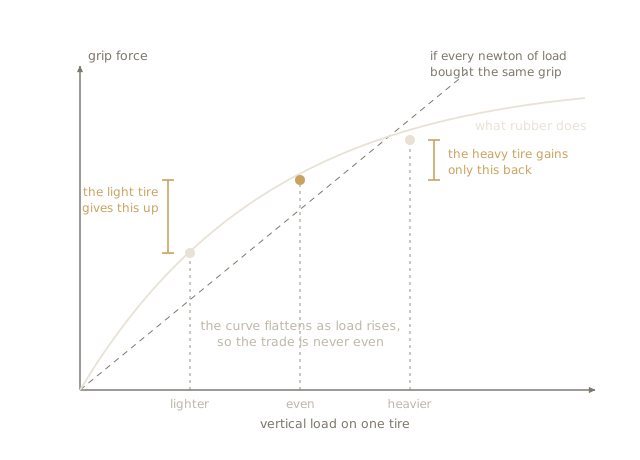
The consequence is easiest to see as pure arithmetic, with round numbers invented for the illustration and nothing else. Take an axle carrying 800 kg, split evenly at 400 kg per tire, each tire at a grip coefficient of 1.00, and let the coefficient fall by 0.10 for every 100 kg a tire sits above 400 kg and rise by the same below. Balanced, the axle returns 400 times 1.00 twice, 800 units of grip. Now corner hard enough to shift 100 kg across the axle, 500 kg on one tire and 300 kg on the other. The heavy tire drops to 0.90 and gives 450. The light tire rises to 1.10 and gives 330. The axle returns 780. Same total load, 20 units less grip, because the coefficient lost on the heavy side is larger than the coefficient gained on the light side. The curve bends, so the trade is never even.
That arithmetic is the reason the garage menu exists. Springs, anti roll bars, and ride heights are, almost without exception, tools for deciding how load distributes among the four tires, and the bending curve converts that distribution into total grip and balance. The introduction planted this flag and promised the measured version later in the series; this lesson only makes the mechanism concrete enough to reason with.
Why the cloud is round at its corners
Plot every sample of a lap as one point, cornering on one axis and braking or traction on the other, and the picture that appears has a name: the g-g diagram. Reading one is simple once its parts are named. The center is a car doing very little, coasting between corners. The pure top, bottom, left, and right are the whole budget spent on one job: all braking, all traction, all cornering one way. And the edge of the cloud is the most the tires delivered that day, in every direction at once.
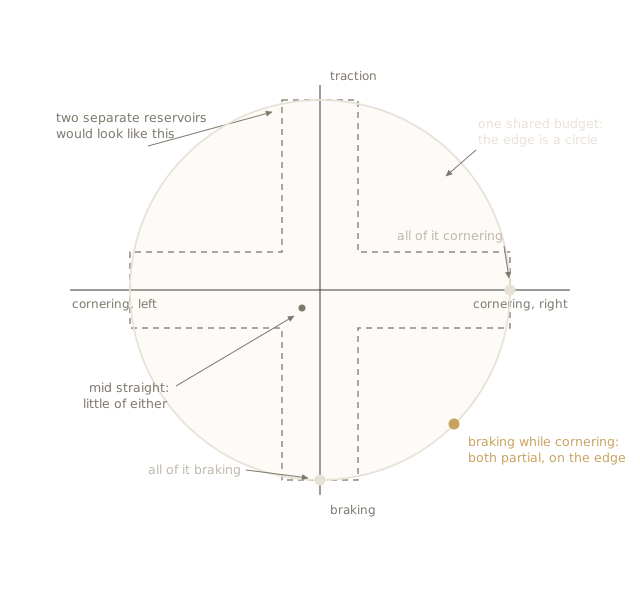
The shape of that edge is the lesson. If braking and cornering drew from two separate reservoirs, the cloud could reach full braking and full cornering independently and would look like a cross. It does not, on any lap, in any session. The rounded edge says a tire braking and cornering at the same moment is sharing one reservoir between the two jobs, and the introduction's own lap shows it.
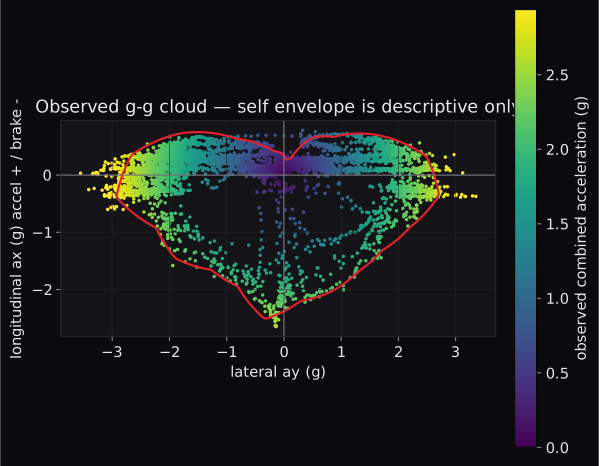
The sharing has a precise geometry, and the series gives it a full chapter; the thing to carry from the introduction is only that the reservoir is one.
Why the hot pressure is the one that matters
The cold pressure is a number chosen in the garage. The hot pressure is a number the run produces, as the gas inside warms with the tire and expands. The introduction's stint showed every tire leaving at 124.1 kPa cold and climbing until about lap 8, then holding, the left front near 137 kPa, the left rear near 139, within about half a kPa for the rest of the run. That plateau is thermal equilibrium: the tire shedding heat as fast as the driving adds it. The craft, in the sim exactly as in the real paddock, is choosing the cold number so the hot number lands where the tire works best.
Why the honest read stopped
Across the introduction's sixteen laps, the tires gained roughly twenty degrees and the lap times fell slightly. It would have been easy to write that the heat was helping. The page refused, because over the same laps the car burned 24 kg of fuel and the track was gaining rubber, three mechanisms moving together, and that session alone cannot split the credit. This refusal is not caution for its own sake; it is the method the whole series runs on. Entangled causes get separated by controlled experiments, one variable at a time, or they stay entangled and the page says so.
Sources
- The introduction this lesson deepens: Grip Leaves a Fingerprint, including every measured number restated here, from telemetry session
f78654b67c69e481cited on that page. - The axle arithmetic in the load section uses round values invented for the illustration; it is a demonstration of the bending mechanism, not a measurement of this car.