Nothing you do touches the road
Look at a race car and you see an engine, wings, brakes, a driver. Not one of them touches the ground. Four patches of rubber do, and each is about the size of your hand (Smith, Tune to Win, p.12; Milliken, RCVD, p.13). Every force that ever turns the car, slows it, or drives it forward is born inside those four little prints. Milliken uses exactly that word for them, the print, the patch of tread pressed flat against the road at any instant (p.14).
This is worth sitting with, because it reorganizes how you think about the whole machine. The engine does not move the car. It spins the rear tires, and the tires move the car, or fail to. The wing does not hold the car down. It presses on the tires, and the tires do the holding. The brakes do not stop the car. They clamp the discs, and the tires stop the car, or lock and skid. Smith runs everything, the accelerations, the control, even most of what the driver feels, through those four patches (p.12). So for this entire study, keep one sentence in your pocket: I am always, only, talking about four patches of rubber. When springs and aero and the differential turn up later, I am still only ever talking about what they do to those four patches.
Rubber breaks the rule you learned in school
In school you were taught that friction is tidy. The grip force is a fixed fraction of the load pressing down, written $F = \mu N$, where $N$ is that vertical load and $\mu$, the Greek letter "mu", is the coefficient of friction, a number that lives somewhere below one. Steel on steel, a book on a desk, a block on a ramp. Clean, and small.
A race tire simply ignores this. Put 500 pounds of load on one and it will hand you 800 pounds of grip. Rearrange the schoolbook formula and the coefficient comes out at $\mu = F / N = 800 / 500 = 1.6$ (Smith p.12). Milliken has measured grand prix rubber up near $\mu = 1.8$ at light load (p.27). A number well above one. The grip is larger than the load pressing the tire into the road. If the only friction you know is the block on a ramp, that is supposed to be impossible.
It is possible because rubber does not simply rub. Two things happen at once inside the print (Smith p.13; Milliken p.14). The rubber keys mechanically into the microscopic hills and valleys of the road, folding itself into the texture the way a soft eraser drags and grabs on paper. And when it is loaded hard and warm, it forms brief molecular bonds with the surface, a real stickiness, gone the instant that scrap of tread lifts away. Mechanical keying plus adhesion. That is why a tire can lay a black mark without the car sliding at all, and why the coefficient is not a fixed property of two materials but a living number that shifts with load, temperature, surface, and speed (Smith p.12). The tire is not a block on a ramp. It is a soft, sticky, restless thing, and it is far more interesting than the schoolbook let on.
The tire points one way and rolls another
Here is the idea that separates the people who understand cars from the people who repeat things they overheard.
Push a stationary tire sideways and it does not slide at once. It flexes, like a stiff spring, and pushes back in proportion to how hard you shove (Milliken p.16). The tread and the carcass behave like two springs stacked in series (p.22). Now let it roll while that sideways push is still on it, and watch a single element of tread from the moment it enters the front of the print. It grips the road and stays put, but the wheel keeps easing sideways, so that stuck element gets dragged off to the side, further and further the deeper it travels through the print, stretching like the spring it is. Near the back of the print the stretch finally beats the grip, and the element lets go and snaps back (Milliken p.18).
Add up every element doing this and the whole tire ends up rolling along a line a few degrees off from the direction it is actually pointing. That angle, between where the tire aims and where it travels, is the slip angle, written $\alpha$ (alpha). It is the single most important angle in the sport.
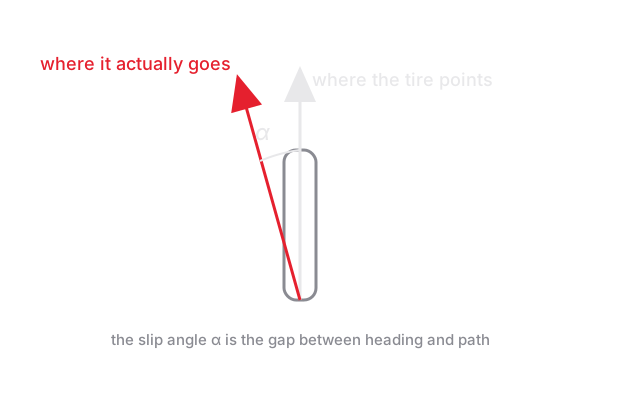
Now the part that feels backwards the first time you meet it. The tire makes its cornering force because of that angle, not in spite of it. No slip angle, no side force, no corner (Smith p.13). The force and the angle are one event seen two ways. You do not steer the tire and then, separately, wait for grip to appear. Turning the wheel sets a slip angle at the front tires, the slip angle is the tire stretching sideways, and that stretch is the cornering force. Milliken draws it as walking forward while sliding each foot a little sideways as it lands, as if the tire had an endless number of feet around its rim, each one planting and slipping in turn (p.19). Smith is careful with the word: slip does not mean slide (p.12). In the useful range almost nothing is actually sliding. It is a rolling spring, not a skid. And the slip angle is not the steering angle (p.13). You can have the wheel cranked hard over with very little slip angle, or nearly straight with a great deal of it. All the tire cares about is the angle between its heading and its path.
There is a lovely consequence in the way a corner actually loads up (Smith p.15). You turn the wheel and for a beat nothing happens. Then the front slip angles build and the nose starts to take the corner. As the car begins to rotate, its own momentum leans on the rear tires through the chassis, the rear slip angles build in their turn, and after a little settling the car arcs through the corner in balance. The whole thing is a fast conversation between four springs, and it begins at the front and arrives at the rear a fraction of a moment later.
More angle, more grip, right up until less
So slip angle makes force. Naturally you want to know how much, and what happens when you ask for more. Plot the cornering force against the slip angle and you get one of the two or three curves you have to know cold (Milliken p.24; Smith p.14).
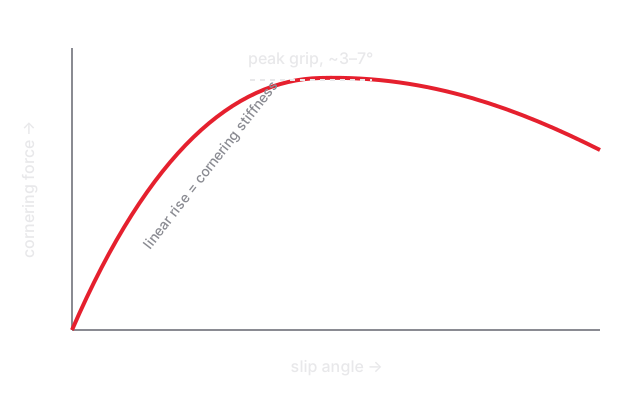
It comes in three parts. At small angles the force climbs almost in a straight line, quick and faithful: ask for a little more, get a little more. The steepness of that first straight stretch has a name, the cornering stiffness, and it says how sharply the tire answers the wheel (Milliken p.24). Then the line begins to bend over as more and more of the print gives up gripping and starts to slide, the sliding creeping forward from the most heavily loaded part of the patch (Smith p.14). Then it rolls over a peak, the most force the tire will ever give, and starts to fall.
Where the peak sits matters. A dry race tire reaches it somewhere around three to seven degrees of slip (Milliken p.24). Smith gives real numbers for a big Can-Am rear: a maximum coefficient near 1.4 at about ten degrees, and, importantly, the curve stayed nearly flat from nine degrees all the way to fourteen (p.15). That flat top is the whole game. Smith describes the tire you want as one that rises quickly to about eighty percent of its grip, so the driver can build cornering force fast and with confidence, then holds a wide flat plateau at the top, a reasonably wide tightrope to balance on, and only then falls away gently instead of snapping out from under you (p.14). Racing tires, being low and broad and run hot, tend to reach their peak at smaller slip angles than a road tire, and they do not like being held at big angles, because a big angle is mostly sliding, and sliding is heat, and heat past a point ruins the tire (p.15).
One thing trips up almost everyone: past the peak, the tire has not "let go." Smith is firm about it (p.15). Beyond the peak the tire is still making very large force, only slightly less than its best, and if you ease the angle back the grip comes right with you. The story your hands tell at the limit, that the grip has vanished, is mostly panic. The truth is that you have stepped a little way down the far side of a gently rounded hill, and the way back up is simply to unwind a touch. This is why Smith's definition of a fast driver has nothing to do with hanging the car out at big angles. He says it plainly: the art is not in running the tire at high slip angles, it is in balancing the car, lap after lap, at the angles that give the most useful total force from all four tires at once (p.15). Living on the plateau, not out past it.
What the steering wheel is quietly telling you
There is a second force hiding in the print, and it is the one you feel in your hands. The sideways force does not act at the exact center of the patch. Because the print is distorted front to back, the force sits a little behind center, and that small lever arm has a name, the pneumatic trail (Milliken p.28; Smith p.20). Force multiplied by that lever arm is a torque that tries to twist the tire back straight, a gentle self aligning torque, the same weathervane effect that makes a shopping trolley's wheels swing around to trail behind you. It is a large part of the weight you feel through the wheel in a corner.
Now the beautiful part. As you push the tire toward its limit, that trail starts to shrink well before the grip does. Smith times it precisely: the trail peaks early, then falls away from about halfway up the slip angle curve, reaching its minimum right around the point where the coefficient itself begins to drop (p.20). Milliken works an example in which, over the last single degree of slip angle before the front breaks away, the self aligning share of the steering weight falls by nearly a third (p.32). So the wheel goes light in your hands a moment before the front tire actually gives up. That lightening, "it went all light and funny" is how Smith describes the feel (p.20), is the tire telling you the truth about how much is left, straight up the steering column, before the front ever washes wide. A good driver reads that message without ever naming it. Now you know what it is: the pneumatic trail collapsing a step ahead of the grip.
Braking and driving are the same story turned sideways
Everything so far has been about cornering, the tire pushed sideways. Turn the whole picture on its side and it holds just as well for braking and acceleration (Milliken p.33; Smith p.16). Instead of a slip angle you now have a slip ratio, a small difference between how fast the tire is spinning and how fast the car is actually travelling over the road. Under power the tread stretches and the tire turns a touch faster than the ground is passing beneath it. Under braking it is dragged the other way and turns a touch slower.
And the curve is the same shape. Grip climbs with a little slip ratio, reaches a peak, then falls, with the peak sitting around ten to fifteen percent slip ratio (Milliken p.37). Below the peak the tire is stable and forgiving: more slip gives more force, and that force fights whatever is causing the slip. Past the peak it is unstable and treacherous: a braked wheel wants to lock, a driven wheel wants to spin up, and both of them run away from you toward less grip rather than more (Milliken p.37). This is exactly why Smith says that visible wheelspin off a corner, or a locked and smoking front into one, is not the maximum. It is proof that you sailed past the maximum a moment ago (p.16). The fastest corner exit, he says, comes from just a taste of wheelspin, never a cloud of it, and the fastest drivers get no wheelspin far more often than they get smoke (p.16). Smoke is not speed. Smoke is a receipt for grip you already spent.
One budget, spent sideways or forwards, never twice
Here is where cornering and braking stop being two separate stories. A tire has one grip budget, not two. It can spend that budget turning, or slowing, or driving, or on any blend of them, but it cannot spend the same grip twice. Draw the total it can make as a circle, and every combination of sideways and lengthways force has to live inside the ring. Mark Donohue called it the "wheel of life"; most people call it the traction circle, or the friction circle (Smith p.23).
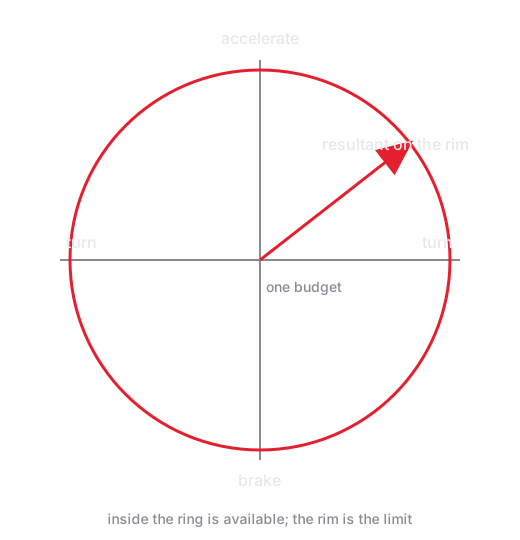
Spend the whole budget cornering and there is nothing left to brake or drive; you are at the side of the ring. Stand on the brakes in a straight line and you are at the bottom, all of the budget spent slowing and none available to turn, which is precisely why a car will not change direction under maximum braking. The useful trick is that the two forces add like arrows, not like plain numbers. Smith gives the example: about 1.1 g of cornering and 0.8 g of braking do not add to 1.9, they combine along the rim of the circle to a resultant near 1.4 g (p.24). So the quick way around a corner is to ride the rim of that circle and never the empty middle. Trail the brakes into the entry while the cornering force is still building, blend smoothly across the top through the middle of the corner, then unwind the steering and feed the power in as the car straightens (p.24). The old habit of braking in a straight line, then turning, then accelerating in a straight line, leaves most of the circle unused, and unused circle is lap time left lying on the road (p.24). Almost everything a driver trains is really the one skill of staying out on that rim without falling off it.
The quiet bombshell: load sensitivity
Now the fact that runs the entire sport, the one almost nobody says out loud, and the reason a setup sheet exists at all.
Press down harder on a tire and, yes, it makes more total grip. But it makes less grip per pound of load. The coefficient, the grip divided by the load, sags as the load climbs. Milliken measured it on a real tire (p.27):
| Load on the tire | Peak grip coefficient |
|---|---|
| 900 lb | 1.10 |
| 1350 lb | 1.05 |
| 1800 lb | 0.97 |
Double the load and the coefficient falls by more than a tenth. Smith reports the same behavior and explains the mechanism (p.16): the contact patch barely grows when you add load, so the extra weight just presses harder on roughly the same area, the rubber in the print is squeezed to a higher pressure, and rubber under higher pressure resists shear a little less well. More load buys more grip in raw pounds, but at a poorer rate of grip per pound. That one sentence, more load gives less grip per pound, is the seed of nearly every setup decision you will ever make.
Watch what it does to a pair of tires on one axle, because this is the payoff. Sitting still, the two tires on an axle share the load evenly. The instant the car corners, it leans and throws load onto the outer tire and lifts it off the inner. The total load on the axle has not changed at all; it has only been split unevenly. And because the coefficient sags with load, the heavily loaded outer tire is now working at a worse rate, while the lightly loaded inner tire is working at a better rate but has almost no load left to make force with. The two do not cancel out. The loss on the outer tire beats the gain on the inner, every single time. Smith runs the numbers (p.17): two front tires at 400 pounds each, coefficient 1.4, make 1120 pounds of grip together, about 1.4 g. Now throw the load hard to the outside, 720 pounds on the outer and 80 on the inner, and the pair now makes about 1056 pounds, roughly 1.32 g. The exact same total weight sits on that axle. It simply makes less grip, because it is split unevenly (p.17).
An evenly loaded pair of tires makes more grip than an unevenly loaded pair carrying the same total load (Milliken p.28; Smith p.17). Read that twice, because it is the whole reason a race car has springs, and anti roll bars, and carefully chosen ride heights, and a ballast plan. None of those parts exist to make the car "stiff." They exist to manage how load is shared, between the two tires on an axle and between the front and rear axles, so that no single tire gets buried and dragged down its own load sensitivity curve any further than it must. Every spring rate, every degree of camber, every millimeter of ride height in the rest of this study is a footnote to this one curve quietly bending over.
The other face of the same coin: why we bolt on wings
Load sensitivity has a bright side, and it matters just as much. The coefficient sags with load, but only gently, while the load itself can be raised a great deal. So the absolute grip, the real pounds of force, still climbs as you add load, because the load rises faster than the coefficient falls. Smith walks it right up (p.16): a pair of rear tires at 500 pounds each and coefficient 1.35 makes about 1350 pounds of thrust. Add a hundred pounds of load to each through rearward weight transfer and the coefficient slips slightly to about 1.33, but the thrust rises to nearly 1600 pounds. Now press an extra 400 pounds of aerodynamic download onto them and the coefficient sinks to about 1.26 while the thrust climbs past 2000 pounds. That, as Smith says, is exactly why we bolt wings onto the thing in the first place (p.16).
So hold both halves of this at once, because together they are the key to the whole car. Adding load to a tire always buys more grip in absolute pounds, which is why downforce is close to free lap time and why the loaded outer tire is the one carrying the car through a corner. But adding load always costs you grip per pound, which is why piling load unevenly onto one tire throws total grip away. Downforce presses on all four tires at once, so it is nearly pure gain. Body roll and weight transfer press on one tire at a time, so they are a tax. A race engineer spends his working life on that single trade.
The tire only works inside a window
Two last practical truths, because a perfect grasp of slip curves is worth nothing if the tire is the wrong temperature or the wrong pressure, and Smith spends real ink here (p.18).
Grip needs heat. Most road racing tires reach their best grip only inside a fairly narrow band of tread temperature, roughly 190 to 220 degrees Fahrenheit for a typical dry compound, which is about 88 to 104 Celsius (p.18). Below the band the rubber is glassy and will neither key nor stick, and the car simply has no grip, no matter how clever the setup. Above it the surface greases over and begins to tear itself apart. A cold tire and an overheated tire are both slow, for opposite reasons, and a great deal of what a suspension quietly does is keep the tire inside that window lap after lap.
And pressure sets the shape of the print. A modern racing tire leans on its inflation pressure to hold the designed curve of its tread flat against the road (p.19). Too much pressure and the tread crowns upward, so the tire rides on a narrow center strip and loses print. Too little and the tire goes vague and squirms and cooks itself in the middle of the tread from all the flexing. The pressure that matters is the hot pressure, the one the tire settles at once it is up to temperature, and chasing it is one of the oldest crafts in the paddock.
Where this leaves us
Step back and the tire is one coherent object. It is a spring that trades a small slip, sideways or lengthways, for a large force, all of it made inside a handprint of rubber. It gives more force as you ask for more, up to a rounded peak near a few degrees of slip, and it warns you through the wheel, going light in your hands, a breath before it lets the front wash wide. It has one grip budget to spend in any direction and never twice, so the fast way around is to ride the rim of its circle. It hands you more grip in raw pounds as you load it, and less grip per pound at the very same time, which is the whole reason setup exists. And it will do none of this outside a window of heat and pressure.
That idea of one budget, shared across every direction at once, is where the next chapter goes. Once you accept that the whole car has only so much grip to spend, the natural question is how much it has in every direction at the same time. That picture has a name too. It is called the g-g diagram, and it is the shape of everything a car can do.
Sources: Carroll Smith, Tune to Win, ch. 2 (pp. 12 to 24). Milliken and Milliken, Race Car Vehicle Dynamics, ch. 2 (pp. 13 to 82).