
Four numbers that refuse to sit still
Chapter one ended on the fact that runs the sport: a tire gives more grip with more load, but less grip per pound of load (Smith, Tune to Win, p.16; Milliken, RCVD, p.27). Chapter two drew the envelope of everything the car can do. This chapter is about the machinery that connects them: the thing that decides, moment by moment, which of the four handprints is carrying the car and which is along for the ride.
Here is my car, the one from the Silverstone night the last chapter measured. Sitting still it presses on the road with 6650 newtons, 678 kilograms of car, driver, and fuel, split 2776 N across the front axle and 3874 N across the rear. About 42% front, 58% rear (the sim publishes each corner's static load on the setup sheet, so these are read, not estimated). Those four static numbers are the only honest constants in this story. The moment the car moves, the loads never sit at them again.
And here is the point Smith builds the whole chapter on: in every brake zone, every corner, every squeeze of throttle, the total stays the same, because no braking or cornering adds a gram of mass, but the distribution swings enormously (Smith p.27 and onward). The weight doesn't move. The load does. It is a loan, taken from one axle or one side and handed to the other, repaid the instant the acceleration stops. And because of load sensitivity, every loan costs interest, paid in grip.
The braking loan, measured
The arithmetic is almost embarrassingly simple. Under longitudinal acceleration, the load that crosses from one axle to the other is the inertial force times the height of the center of gravity, divided by the wheelbase (Milliken pp. 684 to 685):
$$\Delta W = \frac{h}{\ell} \, W \, a_x$$
Tall car, short wheelbase: big transfer. Low car, long wheelbase: small transfer. That's the entire formula.
Run it on my car. Wheelbase 2.866 m. Center-of-gravity height about 0.30 m, and I should say plainly that this is the one estimated number in the chapter: the sim doesn't publish it, and the instrument flags every number built on it as modeled, not measured. At the 2.1 g of braking my Silverstone lap actually generated, the formula moves about 1480 newtons onto the front axle. The front, static at 2776 N, is suddenly carrying about 4250 N, up 53%. The rear has quietly lost the same 1480 N and sits near 2400 N, off 38%.
Now two things you already know snap into place. First: this is why the brake bias sits where it does. The measured line pressures from chapter two's lap showed 55% of braking pressure going to the front, because under braking the front tires are carrying most of the car, and chapter one taught us that load is what grip is made from. The bias bar isn't a preference; it's an accounting of this transfer. Second: this is why the car will not turn under full braking. The g-g rim from chapter two bends the way it does because the load, and with it the grip budget, has run to the front and to the braking direction all at once.
Watching the loan happen
Here is where the sim gets luxurious. Smith had to infer this transfer with a calculator. We can watch it land on the suspension, twenty times a second.
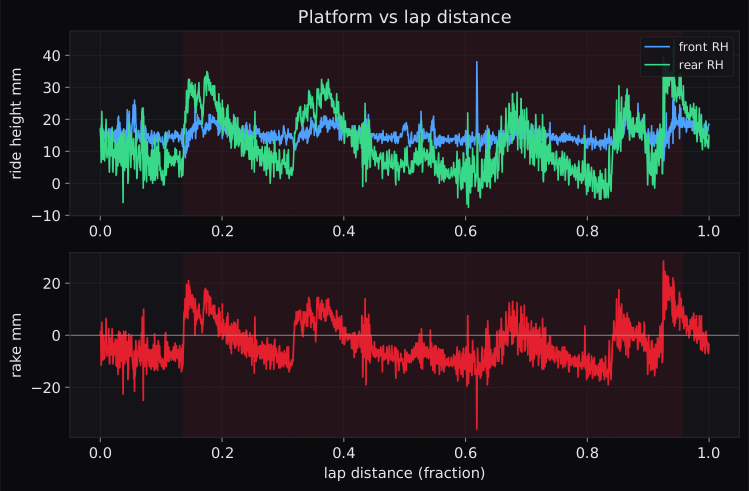
The instrument splits the lap by phase and averages the platform in each one. On the straights this car runs a negative rake, tail low at −7.2 mm, squashed by downforce at speed. In the braking zones the picture inverts completely: the nose dives, the tail rises, and the rake swings to +9.5 mm. That 17-millimeter swing is the 1480-newton loan, written into the suspension travel. The engine's own check agrees on direction: across the whole lap, braking samples show the front shocks compressed and the rears extended relative to everywhere else (front +0.4 mm, rear −6.3 mm). The model says the load goes forward, and the suspension confirms it went.
Cornering shows up the same way. Take the left and right ride heights and subtract: while cornering, this car carries a mean 8.9 mm left-right split, and the split tracks lateral g with a correlation of +0.98, the chassis rolling onto its outside wheels exactly on cue. (A sim-specific footnote: iRacing also publishes a channel literally named roll, and it is nearly useless for this. It's world-frame attitude, dominated by the banking and camber of the road itself, and it correlates with the real chassis roll at just 0.14. Knowing which channel tells the truth is half of instrumentation.)
The sideways loan is the expensive one
Lateral transfer follows the same law with the track width in the denominator (Smith p.34):
$$\Delta W = \frac{h}{t} \, W \, a_y$$
Smith's worked example is worth retelling in his own numbers, because the punchline generalizes. A 1080-lb rear axle load cornering at 1.4 g with a 13-inch CG and a 60-inch track moves 328 lb from the inside rear to the outside rear: 61% of everything the inside tire was carrying. The pair's combined cornering force drops from 1512 to 1400 lb (p.34). Nothing changed but the split, and the axle lost grip. Load sensitivity, collecting its interest. Smith's verdict is blunt: "Lateral load transfer is a bad thing" (p.34). His remedies are the geometry of the formula itself: widen the track, lower the center of gravity, carry less weight (pp. 34 to 35).
Now run my car at the lateral peak the stint lap actually reached, 2.97 g. The formula moves about 2245 newtons across the rear axle. Pause on that number. Each rear tire statically carries 1937 N. The model just moved more load off the inside rear than the inside rear had.
Taken literally, that says the inside rear went to negative load, the tire pulling up on the road mid-corner, which is absurd. And the absurdity is the most instructive number in this chapter. The point-mass model knows nothing about aerodynamics; its assumptions say so on every output. A 678-kg car cannot corner at 2.97 g on its static loads at all; chapter two's speed-banded envelope already showed the grip tripling with speed. What keeps the inside rear pressed to the road while 2245 N runs across the axle is downforce the model doesn't include. The broken arithmetic isn't a bug; it's a measurement-shaped hole showing exactly where the wings' contribution belongs, and exactly why it must be measured rather than assumed. That measurement, coastdowns and constant-speed runs to weigh the invisible load, is already on the test schedule, and it gets its own chapter.
What this buys us
So hold the chapter's one idea firmly: the total load is fixed by mass (and, at speed, by wing); everything the driver does only redistributes it, and every redistribution is taxed. Brake, and the rear axle goes light exactly when you'd like it to help you slow. Corner, and the inside pair goes light exactly when you'd like four tires sharing the work. The g-g rim of chapter two is the boundary of a budget; load transfer is what's constantly reallocating that budget between the four accounts, at a fee.
And now the setup sheet stops being a list of mysteries. Springs, anti-roll bars, ride heights, the center-of-gravity items: none of them can repeal the transfer formulas; $h$, $t$, $\ell$, and $W$ are the only levers those formulas have. What the elastic parts can do is decide how the transferred load is shared between the front axle and the rear, which pair of tires pays more of the tax, and that choice is called balance. Whether the front or the rear runs out of grip first; understeer, oversteer, and the numbers underneath them. That's the next chapter. And unlike the books, which had to describe it, we get to measure it: there is a five-minute test that unlocks the whole steady-state story for this car, and by the time you read the next installment I will have driven it.
Sources: Carroll Smith, Tune to Win, ch. 3 (pp. 27 to 40, worked example and remedies pp. 34 to 35), p. 16. Milliken and Milliken, Race Car Vehicle Dynamics, ch. 18 (longitudinal transfer pp. 684 to 685), ch. 7.4, p. 27. Telemetry: session f2667b334982a50f (Silverstone Arena GP, 2026-07-08), analyzed with the vdyn engine; static loads from the sim's setup readbacks; every load-transfer figure tagged MODELED on a 0.30 m CG estimate and direction-checked against measured shock deflection.