
The shift light lies
Most cars hand you a shift light. It comes on near the top of the rev range, you pull the paddle, and you use the same number in every gear and every corner. That single number is wrong more often than it is right, and the car's own data is enough to show why.
What a gear is for
An engine does not make the same force at every rpm. It makes torque, and that torque rises, peaks, and falls as the revs climb. The gearbox exists to multiply that torque into force at the driven wheels: force at the wheel is engine torque times the gear ratio. A lower gear multiplies more, so it lays more force on the road, but it also spins the engine faster for a given road speed, so it runs out of revs sooner. Every gear is the same bargain, more force and less range, or less force and more range.
What accelerates the car is that wheel force, minus the drag pushing back, which climbs with speed.
Here is the move everything hangs on. At any given road speed you could be in more than one gear, each holding the engine at a different rpm, each making a different amount of force at the wheel. The fastest gear at that speed is whichever one makes the most force. That is the entire criterion.
The shift point falls straight out of it. As a gear winds out, the engine runs past its best and the force tapers. Meanwhile the next gear up, at the lower rpm it would drop to, may already be making more. The moment to upshift is the exact speed where the next gear's force climbs above the current gear's. Two things make it precise. You compare the gears at the same road speed, so the drag is identical on both sides and cancels, leaving only engine torque times ratio. And because the ratio gaps differ for every gear, that crossover lands at a different rpm in every gear. There is no single shift rpm. One shift light for the whole gearbox is an approximation, and a coarse one.
Reading it off the car
You do not need a dyno. Acceleration is proportional to wheel force, and at a fixed speed the drag is fixed, so any difference in acceleration between two gears at the same speed is a difference in the force they are putting down. So you measure it directly: acceleration at full throttle, in each gear, across the speed range. At each speed, the gear that accelerates harder is the stronger gear. Where two gears' lines cross is the shift point.
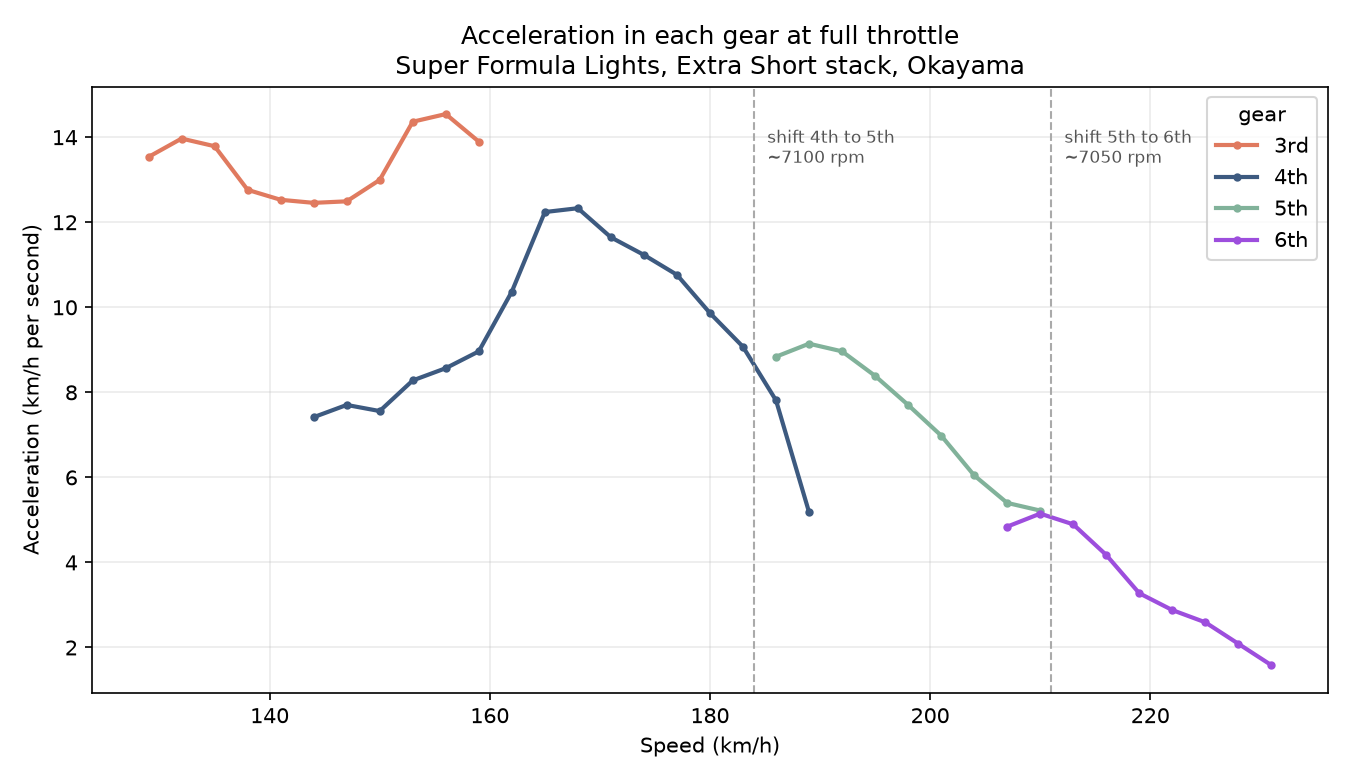
That picture is the whole shift map. Read up to whichever line is highest, that is the gear to be in, and shift where it hands off.
But notice what the crossing point actually is: a speed, not an rpm. The chart has to compare gears at the same speed, because that is the only way the drag cancels and the comparison is fair. You drive by the tach, though, not the speedo, so you carry the crossover across with the gear ratio, the revs the engine turns per km/h in that gear. In this car 4th turns about 38.5 rpm for every km/h, so its 185 km/h crossover lands near 7100 rpm. Do that for each one and the shift map reads, in the units you actually use:
- 1st, 2nd, 3rd: the next gear never overtakes before the limiter, so rev them out to it, around 7200 rpm, as far as traction lets you put the power down.
- 4th into 5th: about 185 km/h, near 7100 rpm.
- 5th into 6th: about 210 km/h, near 7050 rpm.
The shift point drops as the gears get taller, and that fall is the physics showing itself. The short gears have big ratio gaps and force to spare, so the next gear cannot catch them before the limiter. The tall gears have small gaps and are fighting more drag up high, so the next gear overtakes sooner and you short-shift them. In the chart you can watch 4th crater off its limiter while 5th is still pulling.
One caveat the method hands you for free: those rpm numbers belong to this gear stack. Put a longer stack on and the crossovers move. The method does not.
The corner case: when the lower gear is the slower gear
A straight is the simple version. A corner adds one wrinkle that flips the intuition.
Take a corner that sits near a crossover and empties onto a straight. The Okayama sweeper is exactly that: it runs around 180 to 187 km/h, right on the 4th-to-5th crossover above, and it feeds a straight. The instinct is the lower gear, 4th, for drive off the apex, and through the corner that instinct is not even wrong. Near the crossover the two gears pull almost the same.
But the corner is not the prize. The straight after it is.
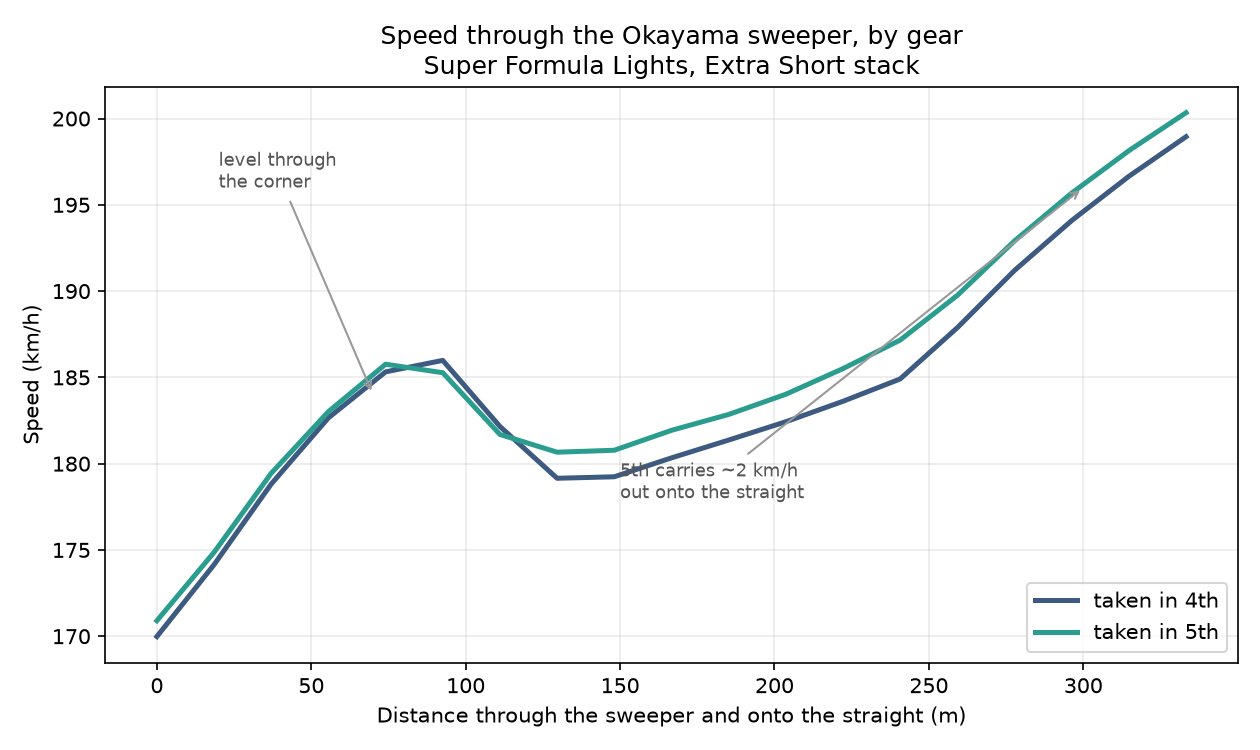
Through the corner the two gears run level. Onto the straight the taller gear edges ahead, and the reason traces straight back to the crossover. The sweeper exit accelerates up through that crossover speed, and above it 5th is the stronger gear, so the car already carrying 5th is in the better gear for the straight while the one still in 4th is past 4th's best, in the weaker gear. The upshift the lower gear still owes costs it a little more on top, but the gear itself is the main story.
The size of the edge, the couple of km/h in the chart, is softer than it looks. It is measured across different laps rather than the same corner taken twice, so some of it is lap-to-lap and not gearing. The mechanism is the firm part: above the crossover, the taller gear pulls harder, and that is what carries onto the straight.
So the straight-line rule grows a corner-shaped corollary: through a corner that feeds a straight, the right gear is the one that carries the most speed onto the straight, not the one that pulls hardest through the corner. The lower gear feels right under the hands and is the slower way through. The data points where the physics already pointed, which is the only reason to trust it.