Adelaide SFL World Record 1:11.532
Uploader-claimed world record as of 2026-02. Verified SFL at Adelaide from video title and description.

Garage61 leaderboard: P3 of 224 · top 1.3% · as of 2026-06-20
Medium-length street circuit: a long straight, a stop-and-go corner sequence, and a technical middle sector. Lap time comes from three places: top speed on the long straight, brake release and rotation in the stop-and-go corners, and exit efficiency onto the straight. Drag is a real constraint here, platform height trades aero efficiency against bottoming on the straight, and exit traction decides the corners that feed it.
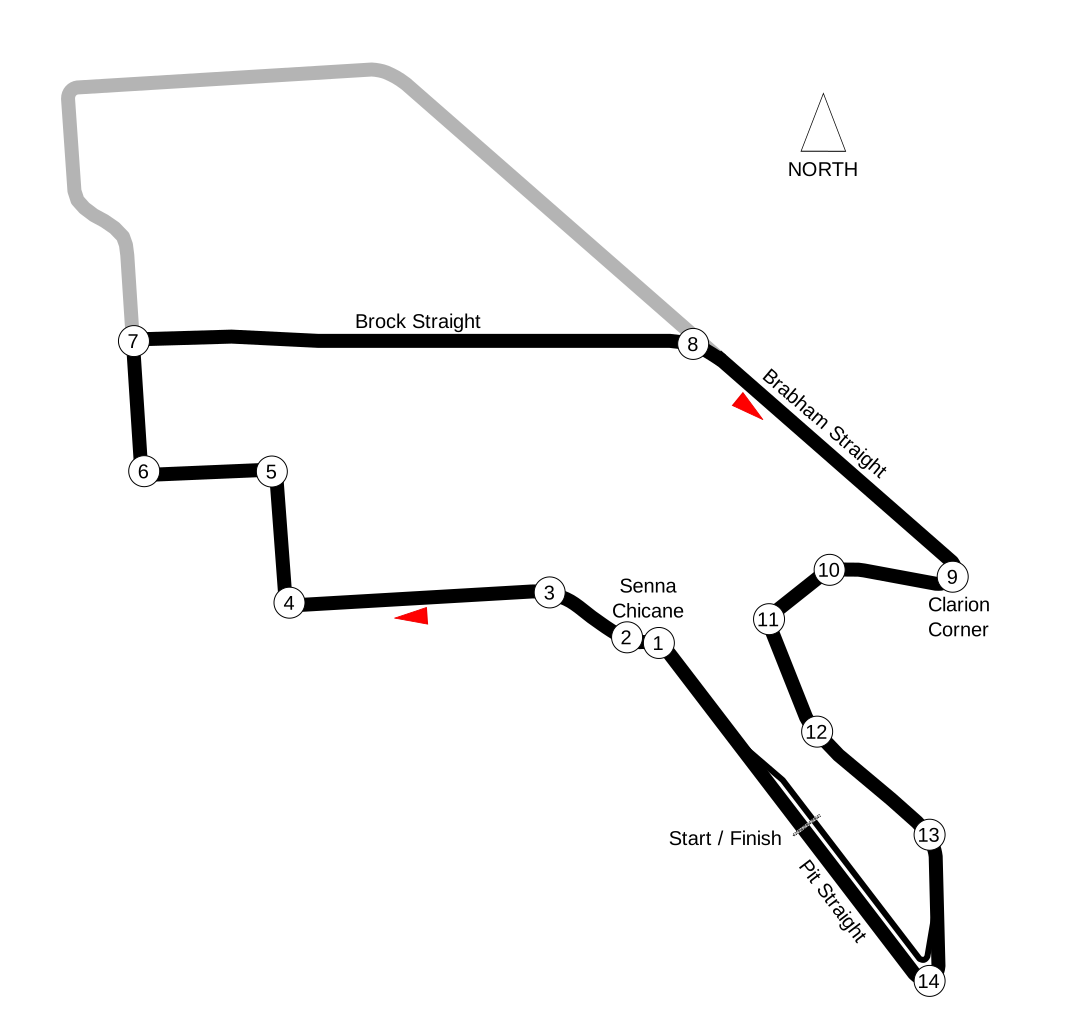
| Length (short layout) | 3.219 km |
|---|---|
| Turns (short layout) | 14 |
| Location | Victoria Park / East Parklands, Adelaide, South Australia |
| Short layout in use | Supercars 1999-2020, again from 2022 |
| Outright lap record (short layout, real world) | 1:16.0357 - Aaron Cameron, S5000, 2023 |
| Full Grand Prix layout, for contrast | 3.780 km |
Uploader-claimed world record as of 2026-02. Verified SFL at Adelaide from video title and description.
One variable at a time, weather held constant for fair comparison (8.05 km/h SW wind, 0.0 RH, 0.0 fog). Verdicts come from the measured laps below.
iRacing fixed/default setup reference.
Best lap: 1:13.654.
Brake bias moved rearward.
A1 plus power-ramp and preload change.
Best lap: 1:13.507. Same-fuel pace close to A1. Driver note: exits felt bound.
A2 ramp shape with lower preload.
Best lap: 1:12.900. Same-fuel lap beat A1 by 0.407s and A2 by 0.452s.
Lower preload probe.
Best lap: 1:12.867. Same-fuel pace was not a clean win over 37 ft-lb.
37 ft-lb baseline with lower rear P-rod.
Best lap: 1:12.851. Best-5 improved by 0.210s vs the 37 ft-lb baseline. S3 sector best improved by 0.029s.
Lower front and rear P-rods from A3.
Best lap: 1:12.636. Theory: 1:12.486. Peak speed stayed near 230 km/h. Front bottoming increased.
A4 front with lower rear P-rod and lower rear beam.
Best lap: 1:12.636. Best-5 spread: 0.129s.
A5 platform with lower wing angles.
Best lap: 1:12.575. Peak speed: 230.6 km/h.
A6 platform with one more aero trim step.
Best lap: 1:12.488. Theory: 1:12.360. Peak speed: 231.3 km/h. Driver note: soft/loose.
A7 aero with stiffer spring platform and lower-direction P-rods.
Best lap: 1:12.233. Theory: 1:12.046. Peak speed: 231.6 km/h. Top-5 long-straight front bottoming: 10.36% -> 5.38%.
A8 with rear P-rod lowered one more step.
Best lap: 1:12.018. Theory: 1:11.848. Peak speed: 232.09 km/h. Wind: 8.05 km/h SW.
A9 with rear P-rod lowered one more step.
Best lap: 1:12.099. Theory: 1:12.063. Peak speed: 231.84 km/h. Loaded bottoming dropped, but lap time, theory, and peak speed were worse than A9.
A10 with front ride height lowered.
Best lap: 1:12.097. Theory: 1:12.067. Peak speed: 231.66 km/h. S3 minimum: 29.538. Front bottoming increased versus A10. A follow-on session the same night, front -25.0 with the A9 rear restored, measured 1:12.284 / 1:12.109: the front position alone costs about 0.26 s versus A9. The front P-rod was not returned to -24.0 afterward and silently carried into the next lab day.
Rear camber tests run while the rejected A11 front P-rod was still in the car.
The front P-rod alone measures 0.27 s best / 0.26 s theoretical (single-variable, same night as the PB) and explains essentially the whole day's deficit. At constant front -25.0: -2.2 deg gave 1:12.247, -2.3 deg 1:12.143 / 1:12.010 theoretical, -2.5 deg 1:12.284 / 1:12.109, so -2.3 was fastest of the three at that front height. Rear inner-edge heat (the motivating concern) ran 10-15 C over the outer at -2.5 and narrowed only 1-3 C at -2.3, with no pace fall-off in any -2.5 run.
A12 with the rear upper flap lowered.
Best lap: 1:12.545 in 4 timed laps. Peak speed unchanged at 232.1 km/h, so the drag relief never showed up. Reverted within the hour.
Three changes at once from A12.
1:13.009 in the only timed lap; abandoned after 2 laps. Three variables moved at once, so no single-variable conclusion, but the rear platform clearly needs the third spring at the 166 N/mm corner-spring rate.
A12 with lower diff preload.
Best lap: 1:12.283 in 4 timed laps; S2 matched the day's best. Within execution noise of 50 Nm. Needs 8-12 lap stints per setting to separate.
Full A9 spec restored after the two-setting drift was found.
Best lap: 1:12.049. Theory: 1:11.902. New all-time S1 best: 23.135. The ceiling returned with the front end, closing the attribution: the -25.0 mm front P-rod was the deficit. The remaining S3 giveback concentrates in the corner at 75% lap distance and the final-corner exit.
The A12 question rerun as a single variable on the verified A9 front end.
Back-to-back against the same-evening A9 re-baseline: best 1:12.171 vs 1:12.049, best-5 average 1:12.373 vs 1:12.210, theoretical 1:12.127 vs 1:11.902. Slower in S1 and S3 minima, equal in S2. Driver call before the data: -2.3 kills the setup. Confirmed. Rear camber stays at -2.5 deg.
Diff preload 50 -> 45 Nm on the verified A9 platform.
45 Nm, 8 laps: best 1:12.180 and the best S1+S2 ever recorded (42.578). 50 Nm, 4 laps each: 1:12.289 and 1:12.226. Within execution noise. Rejected by driver call: the seat never preferred it and 50 Nm holds the lap and ceiling.
Diff preload 50 -> 40 Nm, single variable verified by setup diff.
Best 1:12.107 vs 1:12.049, theoretical 1:11.908 vs 1:11.902: net zero at the ceiling. The shape moved: hairpin zone 0.07-0.08 faster with the four best hairpins of the combined set, S3 average 0.08 better, S2 consistently 0.03-0.04 worse. All three driver reads confirmed. A closing 45 Nm session then set the all-time S2 best twice (19.239 / 19.240). Evening picture: 50 holds the lap and ceiling, 45 the S2 records, 40 the hairpins. Rejected by driver call: the shape trades never earned the seat's preference. The preload chapter closes at 50 Nm.
One front ARB blade step softer on the preload-40 base, single variable.
Direction came from the seat: slight understeer everywhere, and one blade softer is the manual's less-understeer step. First read, 3 laps, leaned positive. The deciding run went three steps softer on the ordered blade ladder (2-3 to 1-5): 1:12.380 best / 1:12.263 theoretical over 8 valid laps, lazy and slower by the driver's read with the stopwatch agreeing. Rejected; the understeer is not front-roll-stiffness-limited and the blades returned to 2-3.
Rear ARB arm length Position 1 -> Position 2 (1 = longest/softest, 7 = shortest/stiffest; the keeper runs full soft).
Two sessions, 17 valid laps: theoreticals 1:12.027 and 1:12.243 vs the A9 references at 1:11.902-1:11.978. The hairpin rotation gain was real (+5 km/h apex, zone faster than the PB lap) but every loaded corner after it paid it back: 0.15-0.30 per lap lost from hairpin exit to the line, S1 never near its best, S2 0.03-0.04 down. Driver call and stopwatch agree. Both ARB directions measured dead on the A9 platform; the platform stood until the A23-A25 package changed it underneath.
Front torsion bar one step softer plus a lower rear, the first change to beat A9.
The direction came from an external note (Tamas Simon): on this kind of car at Adelaide the inside front lifts on entry and understeers, and the fix is a softer front plus a lower car at the cost of some traction. It measured exactly that way. Clean zone stitch 1:11.992, holding A9's pace with no rejected settings propping it up, and S1 up a tenth on entry. First platform in the lab to stand level with A9 rather than behind it.
Front ARB blades to the softest rung on the lower platform, single variable.
New PB 1:12.009, the first lap to beat A9's 1:12.018. The gains are entry: S1 23.217 (+0.123) and S2 19.207 (a new all-time best) against the old PB, with S3 still 0.166 down. The same 1-5 blades were rejected as lazy and slow on the stiff high A9 car (A20); on the low soft-front car they rotate and set the PB. A verdict measured on one platform did not transfer to the next. The remaining gap to a 1:11.7 now lives entirely in S3.
| Best lap | Theoretical | S1 | S2 | S3 | Laps |
|---|---|---|---|---|---|
| 1:12.009 | 1:11.625 | 23.132 | 19.207 | 29.286 | 268 |
| Date | Type | Best lap | Laps | Sim time |
|---|---|---|---|---|
| 2026-06-14 11:23:15 | practice | 1:12.009 | 7 | 0.22h |
| 2026-06-14 11:14:52 | practice | 1:12.595 | 4 | 0.13h |
| 2026-06-14 11:14:36 | practice | - | - | 0.00h |
| 2026-06-14 11:13:08 | practice | - | - | 0.01h |
| 2026-06-14 11:10:45 | practice | - | - | 0.01h |
| 2026-06-14 11:00:40 | practice | 1:13.575 | 1 | 0.14h |
| 2026-06-13 22:35:12 | practice | 1:12.133 | 4 | 0.37h |
| 2026-06-13 21:52:01 | practice | 1:12.072 | 6 | 0.62h |
| 2026-06-11 09:02:07 | practice | 1:12.335 | 5 | 0.43h |
| 2026-06-11 08:20:45 | practice | 1:12.519 | 8 | 0.55h |
| 2026-06-10 23:36:58 | practice | 1:12.366 | 12 | 0.45h |
| 2026-06-10 23:36:38 | practice | - | - | 0.00h |
Official iRacing Super Formula Lights manual for car overview, garage options, and setup controls.
setup source I want to keep handy
General iRacing setup reference for static and dynamic ride heights, aero platform, bottoming, and the interaction between ride height, springs, fuel, tire pressure, camber, and toe.
Use as general theory around the SFL manual and measured telemetry.
General iRacing setup reference for camber, toe, contact patch tradeoffs, tire temperature, straight-line stability, and tire life.
Use after the main SFL platform and balance problem is close enough that alignment feedback is trustworthy.
General iRacing setup reference for open, locked, and limited slip differentials, including preload and ramp-angle thinking.
Use to interpret coast, power, preload, and rear-axle phase behavior without copying setup-shop values.
SFL overview covering the Dallara F324, aero/bodywork, suspension/platform importance, downforce packages, wing tools, gear stack, and differential controls.
Use as a broad SFL-specific overview; keep paid setup products separate from our own measured learning.