Everything routes through four contact patches
The introduction to this work made one big claim and made it fast: grip is the only force that turns, slows, or speeds a car, and everything else on the machine exists to feed the four patches of rubber that make it. A claim that size should not get to organize a whole course on confidence alone, so I set out to check it.
I could think of only one way to check a claim like that. iRacing talks about the car in exactly two ways, and both of them are lists. While I drive, it streams channels, named quantities recorded many times a second: speed, pedal positions, tire temperatures, suspension movement. Between runs, the garage hands me controls, named settings I can change: springs, wing angles, pressures, brake bias. Whatever the sim will tell me, it tells me through a channel. Whatever it lets me decide, I decide through a control. Walk both lists end to end, ask one question of every entry, which patch does this serve and how, and the claim either holds or it does not.
The sim's own vote
Start with the channels, because the sim answers the question before I do. I took one clean lap at Spa and looked at everything it was willing to record about the car during it. All of it. The lap carried 275 separate channels. Most of them have nothing to do with the car as a machine; they are the sim keeping its own house: frame rate and processor load, network quality, the pit service menus, standings and incident counts, the wheel's force feedback, the cockpit screen, and the sim's own precomputed delta times. Set those 131 aside and 144 are left. That is the car itself, measured sixty times a second.
Here is the part I did not expect. Of those 144 channels, 44 are pointed at the tires and nothing else. Eleven per tire: temperature across the tread at three points and two depths, tread wear at the same three points, and pressure hot and cold. The whole engine, the thing that supposedly makes a race car a race car, gets eleven channels total. Each single tire gets the same eleven as the entire motor. iRacing spends as much telemetry watching one contact patch as it spends watching the engine.
Sorted by what each channel actually watches, the 144 fall out like this:
| What it watches | Channels |
|---|---|
| The rubber itself: temperature at three points across each print at two depths (surface and carcass), tread remaining at the same three points, pressure hot and cold | 44 (11 per tire) |
| The hardware at each wheel: wheel speed, ride height, shock deflection, shock velocity, brake line pressure | 20 (5 per wheel) |
| My hands and feet: throttle, brake, and clutch each recorded twice (at the pedal and after any assist), the handbrake, steering angle, steering lock, torque at the column, gear, shifter, shift friction, brake bias, ABS active and its cut, push to pass and its status | 18 |
| The engine and its fluids: revs, coolant temperature and level, oil temperature, pressure, and level, fuel pressure, manifold pressure, fuel level two ways, burn rate | 11 |
| The body in motion: speed, velocity on three axes, acceleration on three axes, rotation rate on three axes, heading two ways, pitch, roll | 14 |
| Where the car is: latitude, longitude, altitude, distance along the lap two ways | 5 |
| The lap and the session: lap counts and lap clocks, session clocks and flags, pit road and on-track state, the surface under the car, the compound on it, the reset key | 15 |
| The weather the patches work in: air density, air pressure, air and track temperature, humidity, wind speed and direction, precipitation, track wetness, fog, the sky, a wet-tires declaration, sun angle | 13 |
| Traffic and the rules: distance to the cars ahead and behind, the series' weight and power adjustments | 4 |
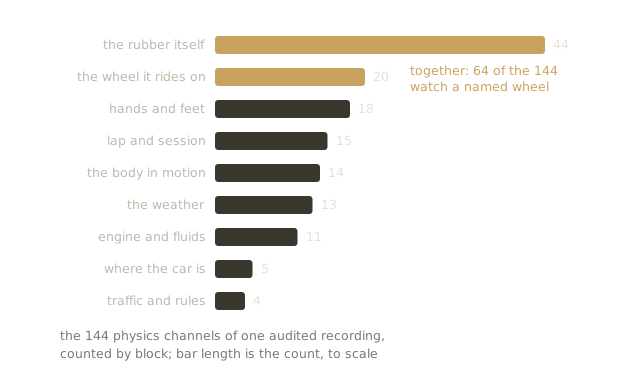
In that table the claim stops being rhetoric and becomes a count. Sixty-four of the 144 channels, closer to half than to a third, watch one of the car's four wheels, and 44 of those watch the rubber on it. Nobody at iRacing ever published a document titled "what matters about this car." They did not have to. The channel budget is that document, and they spent it on the patches.
Everything else on the list traces to a patch as well, in one of three ways, and without a fight. The control and engine channels, 29 of them, are force on its way in: nothing my hands and feet do reaches the road except through a tire. The motion and position channels, 19 of them, are the consequence on the way out, since speed, heading, and altitude are a summary of what the patches already did. The 13 weather channels are the conditions the rubber works in, because grip moves with track temperature and wetness and downforce moves with air density. That leaves the 19 lap, session, and traffic channels, which are not about the car as a machine at all; they exist to tell me when a lap is worth reading, and later chapters lean on them every time two laps get compared. Count them off against the table and nothing is left over: 64 at the wheels, 29 coming in, 19 going out, 13 in the air, 19 keeping the ledger. On the channel side the claim survives whole.
Units carry the physics
The units ride inside the file too, next to each name. Tire temperatures come in Celsius, tire pressures in kilopascals, brake line pressure in bar, wear as a percent of tread, shock movement in meters and meters per second. Those are the units every number in this book keeps, and they are not decoration. A bare number answers no question. 9.80665 is not an acceleration; 9.80665 meters per second squared is. The unit records what was measured and on what scale, and it belongs to the number the way a channel name belongs to a trace.
Units earn that place because they carry the physics, and they carry it in a way that catches mistakes for free. Two quantities add only when their units match: a pressure plus a temperature is not a number, it is an error, whatever the calculator says. Multiplication and division drag the units along with them, so an equation whose units do not balance is wrong before any data arrives. That is the cheapest test in the whole toolchain. It runs on the symbols alone, needs no telemetry, and catches a broken formula before a single wrong number exists.
The standing trap in this work is the g itself. The acceleration channels arrive in g, and turning a g into a force means passing through gravity, 9.80665 meters per second squared, the one constant in the table pinned by definition rather than by any experiment. Multiply a mass in kilograms by an acceleration left in g and the answer comes out wrong by a factor of nearly ten, with nothing on its face to show it. Carry the units and the mistake cannot hide, because kilograms times g do not make newtons until the conversion is applied.
$$m\,[\mathrm{kg}] \times a\,[g] \times 9.80665\,\left[\tfrac{\mathrm{m/s^2}}{g}\right] = F\,[\mathrm{N}]$$
So every number in this book carries two things. The introduction already asked each one to say where it came from: MEASURED straight from a channel, or MODELED through a constant or assumption. The unit is the other half. A value, its label, and its unit travel together, and a number missing any one of them is not finished. A wrong value with the right unit is a mistake you can find. A right value with no unit is not yet a measurement.
The garage, one knob at a time
The channels are what the car tells me. The controls are what it lets me change, and they should trace to the patches just as cleanly, or the claim has a hole in it. So I opened the setup screen and walked it top to bottom, every pane, and restated each control as one sentence: which patch it serves, and by what mechanism. Each restatement is a hypothesis I have not tested yet. It says what to look at when I later change that control on its own and read the tires for the answer, which is the whole method of the setup chapters to come.
| Control | The patch it serves, and how |
|---|---|
| Tire type (dry/wet) | Swaps the rubber itself: changes the grip law at all four patches at once. The wet chapter's whole subject. |
| Cold tire pressure, per wheel | Sets the print's size and stiffness through the hot pressure it produces at running temperature. The hot number is the real setting; the cold one is how you order it. |
| Aero package / front flap configuration | Selects the hardware the other wing controls trim: steps the ceiling on load-without-mass at both axle pairs. |
| Front flap angle | Buys front-pair load with drag; more angle moves the aero balance forward. |
| Front flap gurney | A finer step of the same front-pair load, at the top of the flap's range. |
| Rear upper flap | Buys rear-pair load with drag; the main rear lever. |
| Rear beam wing | Rear-pair load made low, near the floor; also changes what the underbody feeds the rear patches. |
| Front / rear ride height at speed (aero calculator inputs) | Not car controls: inputs telling the calculator what platform to price. Left untyped they keep old values and the calculator prices a car that does not exist. |
| Heave spring (front) | The front pair's rate against pure vertical load: how far the platform sinks under aero load, and how the pair carries pitch. |
| Heave perch offset (front) | Where that spring holds the front platform: static front height, underbody attitude. |
| Push-rod length offset (front) | The front ride height lever: where the front platform sits. |
| Front ARB size / arm length / blades | Three steps of one lever: how much of the roll moment the front pair resists, which decides how much lateral load transfer lands across the front pair instead of the rear. The front half of the balance lever. |
| Torsion bar preload, per front wheel | Trims the static load split across the front pair. |
| Torsion bar outer diameter, per front wheel | The front wheel's spring rate itself: how fast load arrives at each front patch. |
| Compression / rebound damping, per wheel | When load arrives and leaves each patch: the rate of transfer, never the amount. |
| Camber, front and rear | How each print loads across its own width; the three band temperatures are the receipt. |
| Toe-in, front and rear | A standing slip angle built in before the wheel is turned: stability bought at the price of scrub, response sold with it. |
| Rear spring rate / spring perch offset, per wheel | The rear wheels' rate and height: when rear patches take load, and the static rear platform. |
| Third spring / third perch offset (rear) | Rate against pure vertical at the rear pair without adding roll stiffness: holds the platform against aero load while leaving the balance lever alone. |
| Push-rod length offset (rear) | The rear ride height lever: rake lives here. |
| Rear ARB size / arm length | The rear half of the balance lever: the rear pair's share of roll resistance. |
| Front / rear brake master cylinder | Hydraulic leverage per axle: how pedal force becomes line pressure at each pair of patches. |
| Brake pressure bias | Moves braking force between the front pair of patches and the rear pair, and nothing else. |
| Fuel level | Mass on all four patches, placed where the tank sits, falling as it burns: the one load variable the car changes by itself all stint. |
| Gear stack | How engine torque maps to thrust at the rear patches at each speed. |
| Differential ramp angles (coast/drive) | How strongly the two rear patches are tied together off throttle and on it: who gets the torque on exit. |
| Differential clutch friction faces | Steps the diff's total locking capacity. |
| Differential preload | The baseline lock before any torque arrives: how coupled the rear pair is in the transition. |
Every adjustable control in that garage traces to a patch through one of three levers: it changes what a patch carries, it changes when load arrives there, or it changes the shape of the rubber's contact with the road. Springs and bars decide when load arrives and how it splits between the tires. The wings and ride heights add load without adding mass. Camber and toe reshape the print itself. Pressures set what each patch can hold, and the differential decides how tightly the rear two are tied together. Brake bias, the cleanest one of all, does nothing but move braking force between the front pair of patches and the rear pair.
Two entries refuse to trace, and I leave them refused on the page, because the exceptions teach as much as the rule. The dash display page changes what the cockpit screen shows me and touches no patch at all. The two balance-of- performance fields, power and weight, do reach the patches (power changes what the rear pair is asked to put down, weight loads all four), but they belong to the series, not to me; the rules set them, and no setup in this book will ever tune them.
What to carry out of here
The question I put to every channel and every control, which patch does this serve and how, is the working skill of the whole course, and it carries to any car in any sim. Asked of a channel, it tells you what a wiggle on a graph is actually evidence of. Asked of a control, it tells you what to watch after you change it, and the answer is never lap time first. Lap time is the last link in a long chain and the noisiest one; the patch the control serves is the first link, and the honest place to look. Every chapter after this one is the same question asked harder. The tire chapters ask it of the eleven per-tire channels, the load chapters ask it of the springs and shocks, and the setup experiments change exactly one row of that garage table and read the patches for the verdict.
There is one list this whole inventory cannot produce. The forces at the patches themselves, the actual grip each tire is making at each instant, are quantities the sim computes inside its own physics and never streams out to me. That gap is the reason the season has a measurement program at all, and it earns its own chapter at the end of this opening stretch. For now the count stands. The largest block of evidence this simulator gives me about the car is the 44 channels on the rubber, and the garage walk traced every last control to the patch it serves. The next chapter opens the tire's eleven-channel cluster one gauge at a time: what each one measures, when it updates, and the one thing none of them will tell me.
Sources: Smith, Tune to Win, p. 11 to 12 (everything the car does transmits through the four contact patches; the patch is constantly renewed as the tire rolls). Telemetry session for the channel inventory: fc1c2bc75761511d (Circuit de Spa-Francorchamps, Grand Prix, 2026-07-19, six timed laps, 60 Hz, sim build 2026.07.14.02). Garage walk: driver screen captures of every setup pane, 2026-07-19.